
Managing disasters in this “bizarre moment”
Dr. Samantha Montano, an expert in emergency management, weighs in on the state of disaster response and recovery amid the second Trump administration and climate breakdown.
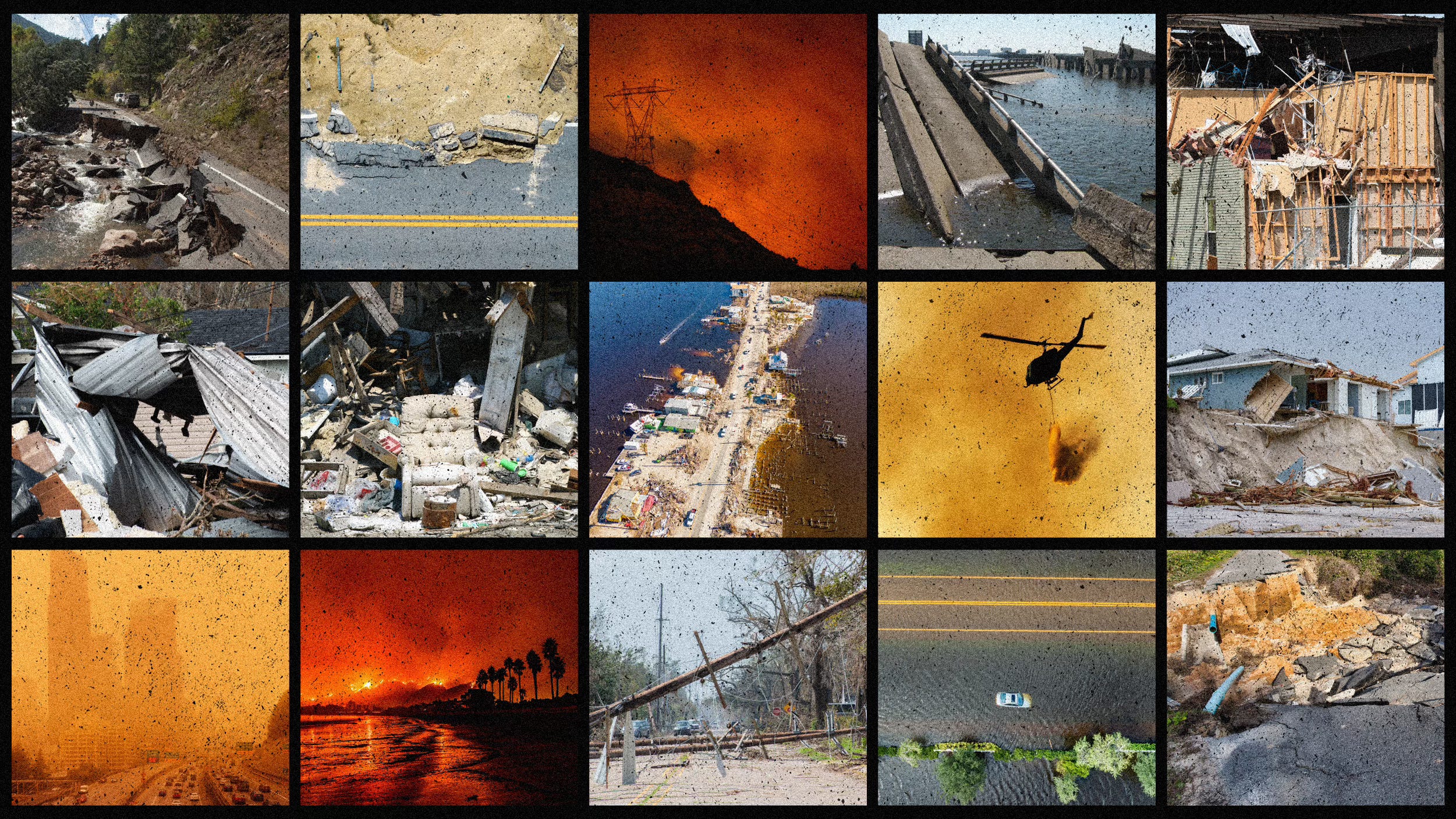
Super Typhoon Sinlaku is slamming the Northern Marianas Islands with life-threatening winds, rain, and floods. The monster storm came remarkably early in the year, hitting U.S. territories in the west Pacific that have long been on the very frontlines of climate change with the least political clout to mitigate the crisis and access resources when it strikes.
As climate-fueled extreme weather events become more destructive, the Trump administration is dismantling the government agency whose mission is to “hel[p] people before, during and after disasters.” While diminishing the Federal Emergency Management Agency (FEMA) and politicizing the distribution of aid, the federal government is doing everything in its power to boost reliance on fossil fuels and to undo regulations on their climate-warming emissions.
“Disasters are absolutely shrouded in injustices from start to finish,” Dr. Samantha Montano told me when we spoke last week, before Sinlaku made landfall. Montano is a self-described disasterologist — a term she uses to describe anyone who studies disasters, from historians and psychologists to sociologists and emergency managers, like herself. After helping gut and rebuild houses in the fallout of Hurricane Katrina and then assisting with recovery efforts during the BP Deepwater Horizon oil spill, she went on to study the policies underlying emergency management in a quest to make the system more efficient and equitable.
Montano is a co-founder of Researchers for Justice and the Center for Climate Adaptation Research, an associate professor of emergency management at Massachusetts Maritime Academy, and the author of Disasterology: Dispatches from The Frontlines of The Climate Crisis. Our conversation about this precarious moment for emergency management in the U.S., edited for length and clarity, is below.
ES: What does it feel like to do this work right now, twenty years after Hurricane Katrina? Since then, we’ve had Helene, Maria, Sandy, Ian, the list goes on. Has our response gotten better or worse, and how prepared do you think we are to respond to the next disaster?
SM: Some things have definitely gotten better. There was a tremendous amount of research done post-Katrina that really expanded our knowledge of how to respond to events like these, how to prevent them, how to go about recovery in a better way. The field has professionalized a lot. Our emergency management system in the U.S. has definitely needed a lot of policy change to make it more effective and more equitable, but we were on the right track until the second Trump administration started.
In the past year or so, we’ve seen a pretty intentional dismantling of a significant portion of emergency management, mainly surrounding FEMA. There is tremendous uncertainty right now about what the future of the agency is, and that’s affecting how state and local [agencies] are able to make plans. We’re in a pretty bizarre moment in the history of emergency management right now.
I saw that Markwayne Mullin, the new Secretary of Homeland Security, where FEMA has been housed since 9/11, now wants states to take the lead on disaster recovery instead of FEMA. What would this mean?
He has said this, other people in the Trump administration have said this, and the actual logistics of what that looks like have not been made clear by any of them.
I think the first thing to understand is that for the vast majority of disasters, it is a locally led response where you have the state and the federal government, particularly FEMA, coming in as support. I think what they’re talking about here is taking FEMA out of the equation, and that is a really scary thing from the perspective of local and state emergency management. There’s a real, fundamental purpose of having that next level of government to be able to rely on.
This idea of removing FEMA from that equation is alarming in the sense of potentially losing a lot of resources. But, importantly, we’re not just talking about money here. FEMA also has expertise in disasters because they’re the ones who are responding all over the country all the time, so especially in places that don’t get many disasters, the expertise that FEMA brings in terms of how to effectively go about a response, how to set up recovery programs, is something that just doesn’t exist at many of our state level agencies.
The third, really important thing that FEMA does is coordinate all the other federal agencies when we respond to a disaster and get those resources down to that state and local level. When we go through a recovery, it’s not only FEMA that is involved at the federal level. It’s the EPA and the CDC and HUD and the Department of Agriculture, and any other possible federal agency. So in the complete absence of FEMA, which at times has been suggested by the president, it’s really not clear who would fulfill that function.
You talk about the expertise that is at FEMA — is that still there since there has been so much gutting of the agency?
There has been a pretty alarming loss of staff at FEMA, either through firing or people leaving. They have lost multiple thousands of people from the agency in the past year. FEMA has experienced what we would call a “brain drain,” where the top leadership, people who have been there a really long time, who have managed dozens and dozens of disasters and have this real depth of experience on how to get the bureaucracy to work in these really critical moments, have left the agency. Certainly, there are many people who are still left at FEMA that do have a lot of experience and a lot of expertise and have been holding on trying to get through this. Whether or not those people are able to maneuver the current leadership and have their voices heard I think is an open question right now.
There’s also, because of the climate crisis, more frequent disasters happening in multiple locations at the same time. How does that impact disaster recovery?
In the past ten years or so, there are so many instances of disasters happening across the country simultaneously or very close together in time. The 2017 hurricane season is maybe the obvious example, where we have Harvey in Texas, followed immediately by Irma in Florida, and then Maria in Puerto Rico at the same time as we had wildfires out in California. That is just a situation where our entire emergency management system becomes extremely strained. Each of those disasters on their own would have required a major response from all across the country in terms of sending resources from states to states, the involvement of the federal government — but to have all of those happen effectively at once pushed our system to its limit.
So it’s really concerning to look to the future knowing that because of our increasing risk, that we will have more disasters in more places, sometimes at times that we wouldn’t expect them to happen, because it means more strain on our emergency management system.
I’ve talked to a lot of people after disasters who are still recovering from a prior disaster, who find themselves trapped in these cycles of recovery and rebuilding. At the local and state level, what types of resources do we need to make sure that doesn’t happen?
You’re spot on: there are a number of places — Southeast Texas, kind of the entire coast of Louisiana, Appalachia, West Virginia, Eastern Kentucky, western North Carolina — some of these places are getting hit repeatedly. You do get trapped in this cycle of not being able to recover before the next one hits, and that actually makes you more vulnerable to that next [disaster] because you haven’t rebuilt yet. So from an emergency management perspective, we need to figure out how to rebuild more quickly. We need to find ways to get more money to more people more quickly, we need to do things like broaden our bench of contractors and construction workers. Some places are finding that they have a shortage of those folks with those specialized skills to even be able to rebuild.
Ideally, you’re preventing these disasters from happening in the first place. So we would be doing more hazard mitigation. Things like moving people out of really high risk flood areas, looking at existing flood infrastructure, making changes to accommodate increased rainfall or whatever the case may be. Looking at other forms of more natural mitigation, like wetland restoration on the coast. A lot of that work needs to be done at the local level, so bringing more attention to emergency management and the need for mitigation among local government and state level government, I think is really important right now, especially in the context of there being so much uncertainty with what’s happening at the federal level.
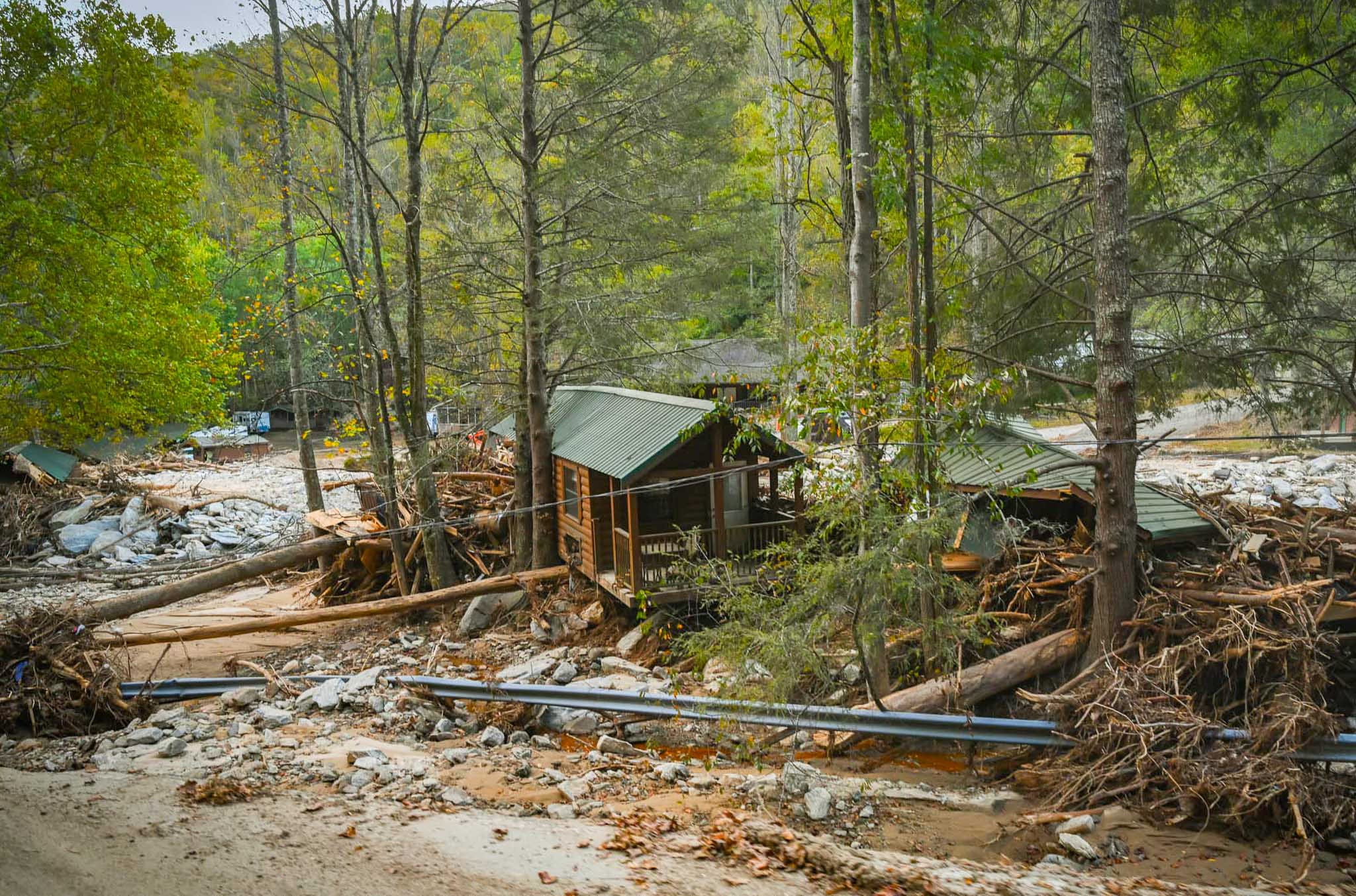
FEMA was ordered by a judge last month to restart the BRIC program, the largest federal grant program for disaster preparedness. Can you explain what that program is, how that money is going to be disbursed, and what happens for the communities that don’t get it?
The BRIC program was actually started under the first Trump administration. There’s been a long history of mitigation grant programs throughout history. This is just the most recent iteration of that. The [second Trump] administration came in and they basically canceled the program and told states they had to return money for mitigation projects all over the country. This obviously was not legal, so a number of states sued the administration to try and get the program back. And the good news is they won those lawsuits, and BRIC has been reinstated for next year. Now states are now going to have to put together grant applications with specific mitigation projects that they’re wanting to do — so that could be anything from relocating a community to building a levy or buying more generators for their shelters. States will submit those grant proposals to FEMA, and FEMA has implemented a new system for looking through those grants and deciding where that money goes.
Thinking about a post Trump world, what would it look like to make sure that disaster response is not politicized? If Democrats regain power in 2028, how should the government be structured differently with respect to emergency management?
The number one thing that needs to happen here is that FEMA needs to be taken out of DHS and returned to its pre-9/11 status as a cabinet-level independent agency. That was when FEMA worked most effectively. We know eliminating barriers of bureaucracy in the midst of a crisis is always a good thing. And certainly, the vulnerability of FEMA to political agendas being within DHS is just completely unacceptable.
Hiring people needs to be a number one priority here. We also need to look back through all of the mitigation, preparedness, response, recovery programs that FEMA has, at what’s working, what’s not working. Things like the formulas that are being used to give out grants and making sure that those are equitable. We also really need to look at FEMA’s overall budget and find some other ways of pushing more money towards mitigation, whether it’s BRIC or some other mitigation grant program, to get that money out to state and locals to be doing that work. And then certainly we need to find ways to speed up the recovery process. Some of it requires Congress, but we really need to have a clear plan going into the next administration in terms of how to do all of this and to do it as quickly as possible.
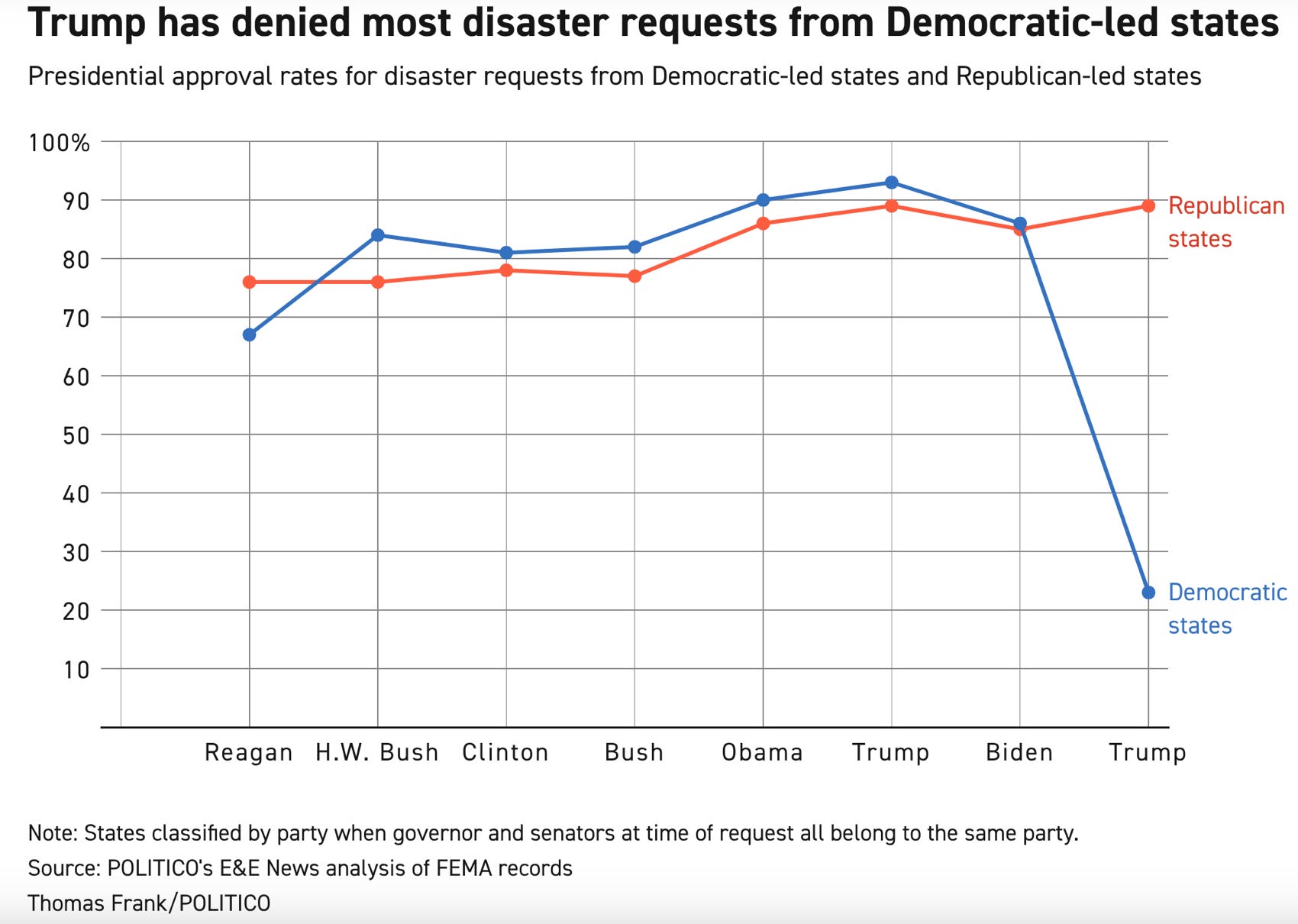
There was an analysis done by Tom Frank at E&E News that demonstrated a clear red versus blue in terms of how the President is issuing disaster declarations. That is a massive deal, because all of those blue states are getting locked out of recovery money. Whether that’s households who can’t apply for money to fix their houses, all the way to local governments who now don’t have the money to fix their roads and bridges and schools — when the next administration comes in, we are going to have a backlog of recoveries across the country that are going to require attention.
We have a climate denying administration in the White House right now, but we know that the burning of fossil fuels is causing the climate crisis and making extreme weather events far more frequent and devastating. What is the connection between fossil fuels and disaster management?
Climate change underlies everything we do in emergency management. Most events that we’re responding to at this point are at least in part influenced by climate change. Even ones that aren’t directly linked to climate change are kind of indirectly linked, because of the strain on our resources and the capacity of our overall system. Climate change is not controversial and hasn’t been for a really long time in emergency management, because emergency managers are on the front lines of managing the consequences.
Past that, there’s an important philosophical question that has not been answered yet for emergency management: what is our responsibility in terms of preparing for climate change? Thinking like 10 years, 15, 20, years down the line, the potential disasters that we are talking about are massive. In an ideal world, emergency managers would be planning for those bigger disasters, planning for sea level rise, creating programs and policies well in advance. The reality is that our emergency managers across the country just don’t have the resources to do that. Again, this strikes me as being a resource issue — needing to create positions, hire people to be doing that longer thinking and that longer work of figuring out for specific communities what needs to change now to set us up better to manage those disasters in the future.
So I want to ask about the companies that have made billions of dollars in profits off of products that created the climate crisis. We’re in this moment where the country is trying to figure out what role fossil fuel companies should play in the future of climate disaster recovery and adaptation.
We’re seeing state and local governments taking major fossil fuel companies to court, arguing that they deceived the public about their products and should have to pay to help communities adapt and recover from the damage. Some states are also passing laws to make the companies contribute to climate superfunds for disaster adaptation and recovery. I recently wrote about a growing wave of bills from red states that would shield the oil industry from these actions. As an emergency manager, what are your thoughts?
I think about this in terms of how our understanding of disasters has evolved over time. It used to be the case that disasters were considered to be an act of God, and that they were completely outside of our control. That thinking started to evolve, and we started to think about disasters in terms of natural disasters versus man made disasters. Then largely in the 1970s, I would say, disaster researchers started pushing back against using this term natural disasters, because it kind of removes that human culpability and takes away our responsibility to do something to prevent those disasters from happening.
Now we’re in another situation where we can directly, through attribution work, see how climate change has affected those specific hazards and then translate that, in some cases, to how much of this damage was actually caused or influenced by climate change itself. You can much more clearly identify responsibility for disasters that have happened. So I think of these lawsuits as being part of that evolution.
In the same way that we look to hold oil companies responsible for oil spills or workplace accidents, for me, this falls into kind of that same line of thinking. I think the approach of looking to hold the oil and gas industry accountable for climate damages makes a lot of sense. I think there are other people and companies that are also responsible here that I would like to see also held accountable: developers who build in known high risk flood plains, the local politicians who allow that to happen knowing that there is a significant flood risk for the people who buy those properties, the real estate industry who’s not required to disclose certain types of risks that properties face. If companies don’t know [that they’ll face] consequence for their actions, they tend to take greater risks and have a greater ability to shield the public from knowing about what that risk is.
Note: If you’re looking for context on Super Typhoon Sinlaku, I recommend following climate journalist Rachel Ramirez, who was born and raised in Saipan, one of the islands being hit by the storm.